A year ago, our research revealed banking’s top customer experience priority was using AI to guide people through complex financial decisions. Today, AI has already accelerated to a point where it’s making those decisions on customers’ behalf.
As AI graduates from intelligent advisor to autonomous orchestrator, we spoke to 100 banking and financial services leaders about its impact on CX in banking. We also compared their perspectives to those of 4,000 people across the U.S. and U.K.
The banking and financial services edition of our 2027 CX Trends Report reveals that the emergence of AI-powered financial assistants and advisors is now one of the most influential forces on CX strategy. It sits right alongside the perennial concerns of regulatory requirements and growing competition from fintechs.
But there’s a tension. Customer concerns around trust, privacy, and AI use also feature in those top five most impactful factors. And financial leaders are right to be cautious as 50% of people aren’t yet comfortable letting AI make more decisions for them, even if it consistently delivers the best outcome.
To deliver AI-managed experiences that align with customers’ needs and preferences, banking and financial services brands need to understand how to apply AI intentionally. With that in mind, let’s take a closer look at three of the most important trends shaping AI’s evolving role in CX.
1. Balancing effortless CX with trust
AI has enabled banking and financial services brands to provide the kind of effortless experiences that 90% believe will define the next generation of customer loyalty.
What will this look like in practice? Almost half of banks (45%) expect AI to have the biggest impact on helping customers make complex financial decisions. That’s followed closely by 39% saying it will benefit customers managing finances across multiple providers while also enabling personalized products, offers, and communications.
But that’s not to say banks and their customers don’t see the value of maintaining a degree of friction in the form of human interaction or additional checks in certain situations. An almost identical 49% of consumers and 50% of brands believe friction can be positive when preventing fraud or verifying identity and security. Also, 46% of consumers see the benefit of positive friction when they’re making a high-value purchase or financial decision.
Banks understand it’s a balancing act. Overall, 88% say the most effective customer experiences will remove unnecessary friction while preserving trust and confidence. This is echoed by 78% of people, who say the best experiences balance the convenience AI can bring with trust and reassurance, often in the form of human interaction.
2. Using emotionally intelligent AI to help with decision making
Banking and financial services have the greatest confidence of all industries we surveyed in the power of AI that understands context, emotion, and intent.
More than half (55%) of banks believe emotionally intelligent AI can help customers make important decisions. They also believe AI is well placed to support customers through stressful situations (56%) and adapt assistance to individual circumstances (55%).
Consumers aren’t on the same page just yet. Right now, only 18% are happy for AI to use their data to help them make important financial decisions. They’re more comfortable when their data enables AI to act as an intermediary or in a more administrative role – for example, in resolving a problem or complaint, or transferring them to a person for assistance without them having to repeat themselves.
3. Applying autonomous AI where customers are comfortable
While some people still need convincing to fully embrace autonomous AI in their interactions with banks and financial services, brands expect this to change over the next five years.
Almost half (48%) of banks expect customers to be comfortable with AI managing their day-to-day financial decisions within that timeframe. Looking further ahead, a large majority (87%) of banks and financial services providers believe customers will allow AI to routinely take actions on their behalf within the next decade.
Most banks are busy laying the foundation for AI orchestrating these seamless customer experiences. Sixty percent of banks already allow AI to shortlist products and services for their customers, while 44% entrust it to manage entire end-to-end customer journeys.
These figures are broadly consistent with customers’ current comfort levels. Most customers (65%) are comfortable with autonomous AI shortlisting products and services, while 44% are happy with it managing their spending, budgeting, or savings goals. Perhaps unsurprisingly, the fewest (31%) are on board with the technology making purchases or payments for them.
What banks need to apply AI in the moments that matter
As banks and financial services brands shift to AI-managed experiences over the next few years, it’s vital they consider how to deploy them responsibly. That’s not just a case of introducing guardrails so customers retain meaningful control. It’s also about determining which touchpoints are right for automation and where customers still demand human connection.
This in-depth understanding of customers can only come from a robust data and identity foundation, but just 36% of banks say they have the data and technology needed to support AI-managed experiences. Banks must now turn their attention to building data and identity infrastructure that helps AI recognize customers wherever it encounters them, then shape seamless experiences by using customer context intelligently, transparently, and responsibly.
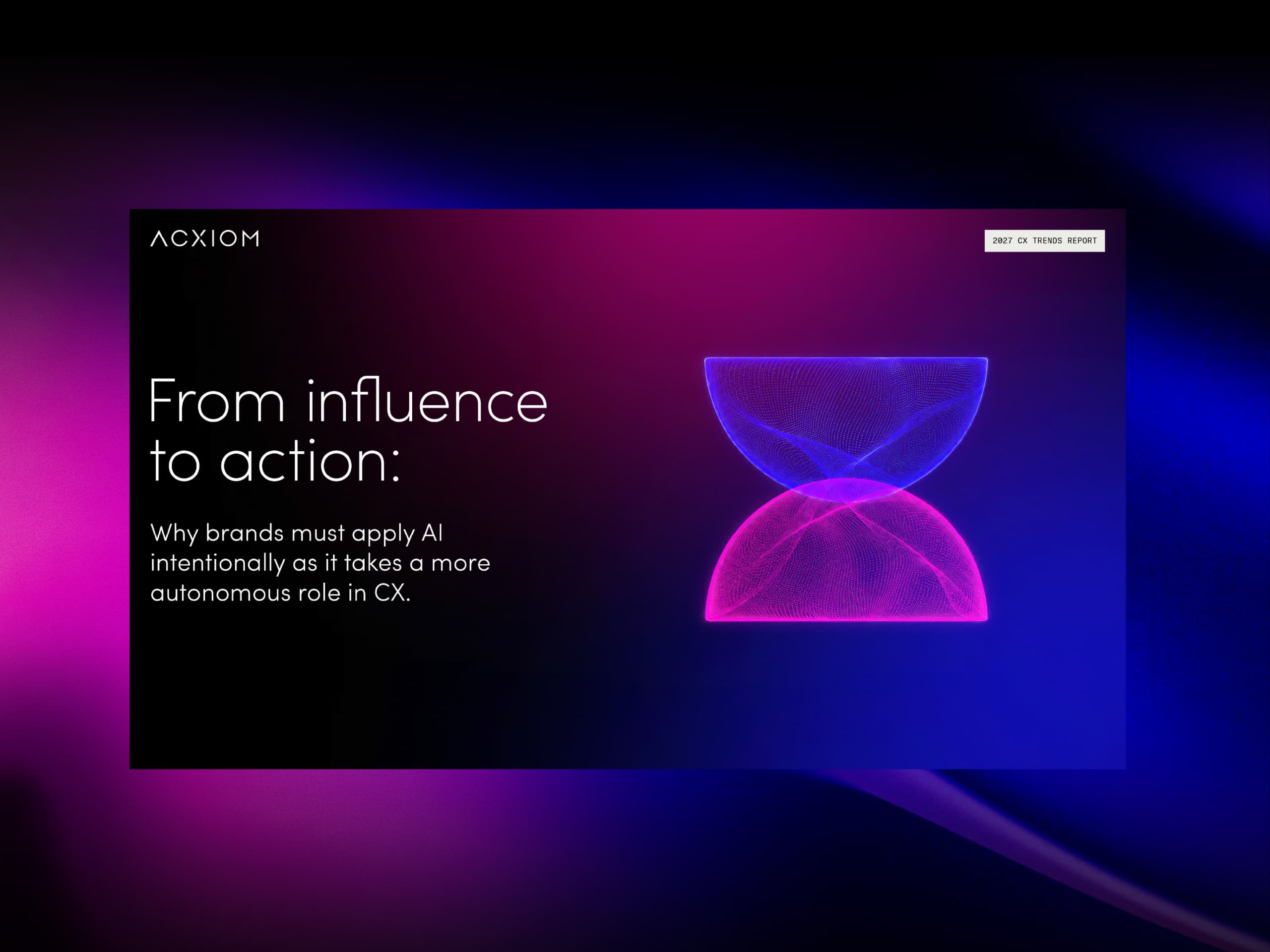
Dive deeper into all five trends in the full report, From Influence to Action: Why Banks and Financial Services Institutions Must Apply AI Intentionally as it Takes a More Autonomous Role in CX, and ensure your AI-driven CX strategy meets your customers’ expectations.


Subscribe to our blog
From the Blog