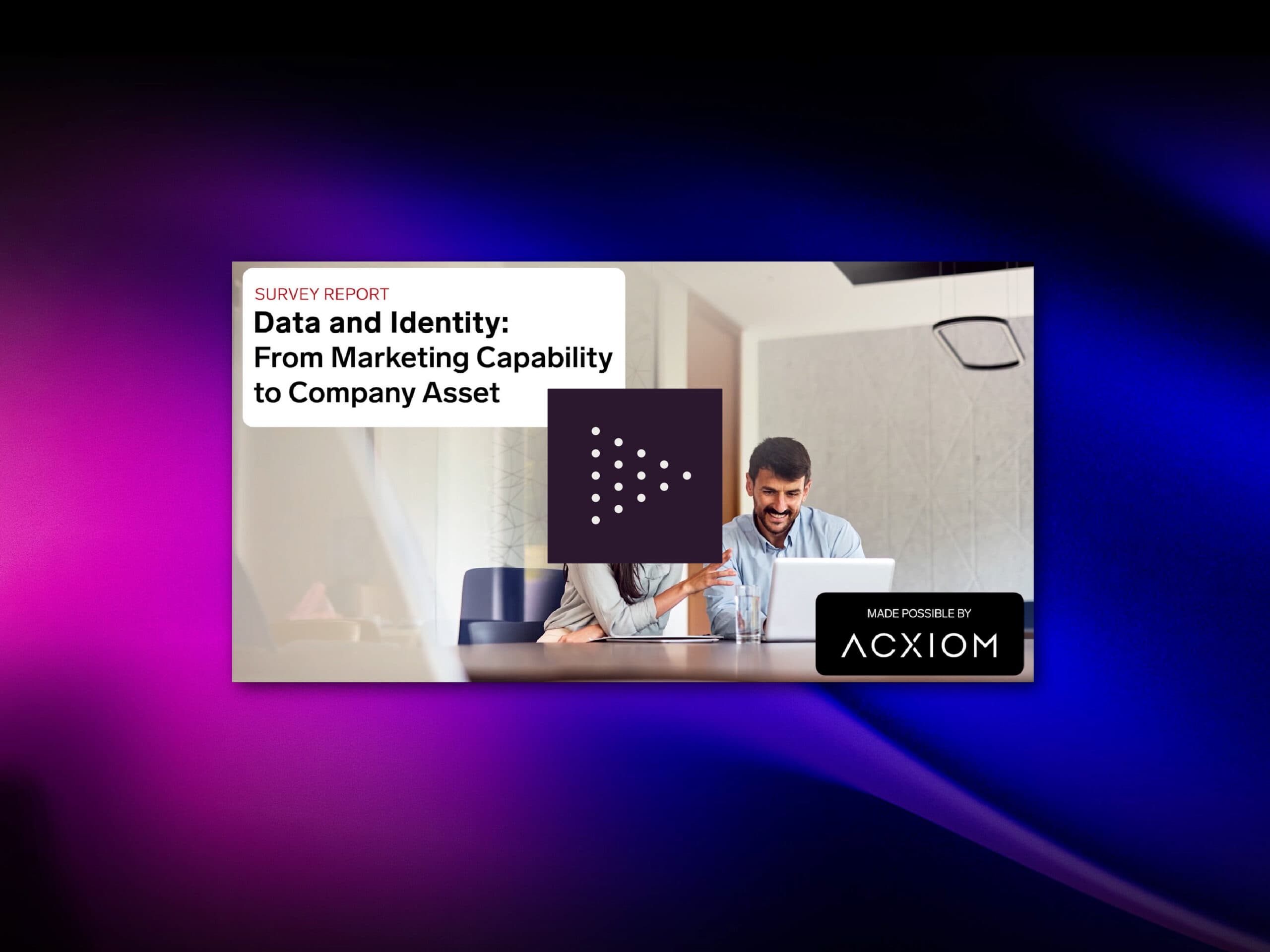
First-party data must form the foundation of any identity strategy, new EMARKETER report finds
New research from Acxiom and EMARKETER reveals why stronger data foundations are becoming essential to maximizing identity ROI, improving marketing performance, and preparing for AI.
July 23, 2026
Identity resolution is delivering impressive results for marketers. But too often, its full potential remains untapped. The problem is clear: many organizations are investing in identity before building a mature first-party data foundation to support it.
A 2026 survey of U.S.-based agency and marketing professionals by EMARKETER and Acxiom reveals more than 90% already use identifiers of some kind to recognize customers across channels. What’s more, 80% report improved marketing ROI as a result of their identity resolution efforts, with 44% describing that ROI as significant, and the biggest gains they reported were in personalization, attribution, and media efficiency. Even more encouraging is that 61% expect their organization’s investment in identity resolution to increase over the next two years.
But identity is only as strong as the first-party data foundation supporting it. Connected, high-quality data helps brands recognize customers, personalize experiences, measure performance, activate audiences, and prepare for AI. Many organizations still need to work on this foundation before they can fully realize the value of their identity investments.
First-party data remains a strategic investment
Google’s plans to phase out third-party cookies in Chrome focused many brands on the critical role of first-party data in effective marketing strategies. And while Google’s subsequent decision to retain cookies changed the conversation, it didn’t change the importance of first-party data.
More than half (52%) of marketers surveyed say their investment in first-party data has stayed the same since Google’s decision, compared with 26% who report slight increases, and just 6% who report significant increases.
Steady investment is encouraging. It shows organizations continue to recognize first-party data as the foundation for effective identity strategies. As signal fragmentation continues and marketers rely on a broader mix of deterministic and authenticated identifiers, connected, high-quality first-party data remains essential to recognizing customers and prospects, improving marketing performance, and preparing for AI.
There are still data gaps to fill
The report’s findings indicate brands still have some work to do before they can establish the unified first-party data foundation needed to support modern identity strategies. For example:
- 42% of marketers rate their organization’s customer data foundation as somewhat or very immature.
- Only 22% say their customer data foundation is advanced or best-in-class.
- 55% say their first-party data is either completely siloed or only partially connected across systems.
These gaps have real business consequences. Fragmented customer data was cited as the biggest factor limiting marketing performance, making it harder to recognize customers consistently, personalize experiences, and accurately measure results across channels.
The impact extends beyond today’s marketing performance. As organizations scale AI, connected and trustworthy customer data becomes even more important. AI can only generate meaningful insights and support confident decisions when it’s built on a strong data foundation. The majority of marketers say their data foundation is unprepared to support AI-driven marketing, and many are already taking steps to address the issue. Almost two-fifths (38%) report that AI and advanced analytics are driving their identity investments.
As Yory Wurmser, principal analyst at EMARKETER, explains, “AI can ingest and interpret much more data to find patterns than older analytics programs. But AI depends on a base of reliable data. It’s the ultimate case of ‘garbage in, garbage out’ without it.”
Identity must be built around first-party data
The strongest identity strategies combine multiple signals, with first-party customer data serving as the foundation that makes every other identifier more effective.
The report shows marketers moving toward a more mature identity strategy, layering multiple signals to create a more complete customer view. Over half (55%) of marketers say they work with more than one third-party identifier, and 53% are using first-party authenticated IDs, indicating first-party customer data is a key part of the mix.
A multi-signal approach is an important step forward, but it depends on connected, accessible, high-quality data. Organizations that continue investing in their first-party data foundation will be better equipped to personalize experiences, improve measurement, activate audiences more effectively, and support future AI initiatives.
The following three steps will help you get the most from your first-party data:
Step 1: Connect your customer data across channels and departments to eliminate silos and create a more complete customer view.
Step 2: Improve data quality by filling data gaps and ensuring customer information remains accurate, consistent, and current.
Step 3: Expand customer intelligence with ethically sourced third-party data that provides deeper insight into customer behaviors, interests, and preferences.
A stronger identity strategy starts with a stronger data foundation. Organizations that invest in connected, accurate, and enriched first-party data will be better positioned to improve marketing performance today while preparing for the future of AI-driven customer engagement.
Acxiom can help you build that trusted data foundation and activate it across the marketing ecosystem, so you can acquire, grow, and retain the customer relationships that matter most.
Book a Data and Identity Health Assessment to see how your first-party data foundation compares with others in your industry and discover the value you could unlock by connecting, improving, and enriching your customer data.
More data and identity insights
Take a look at the full report, Data and Identity: From Marketing Capability to Company Asset, to learn more about how organizations are evolving their identity strategies. Insights include:
- How marketers are embracing interoperability.
- The identifiers used most often today.
- How organizations are managing their identity efforts.


Subscribe to our blog
From the Blog