Forbes Insights: Three ways to prevent data-driven decision-making breaking down in your business
Discover how interoperability, real-time data activation, and connected identity help turn data-driven decisions into measurable growth, better outcomes, and confident action at scale.
September 29, 2026

Gut instinct and educated guesses used to be influential forces when it came to business decision-making, but tightening budgets, increasing marketing complexity, and rising customer expectations have prompted a more rigorous, data-backed approach.
Today, the vast majority of companies use data for at least 40% of key business decisions. That’s according to a new survey of 300 US-based business leaders by Forbes Insights and Acxiom. Those decisions span everything from customer experience and personalization (cited by 61%) to marketing and campaign optimization (60%).
But as Jarrod Martin, chief executive officer at Acxiom, notes: “The amount of data does not correlate with being truly data-driven; what matters is the ability to translate relevant data into desired business outcomes.”
And that’s where things start to run aground. An overwhelming 92% of companies experience breakdowns during data-driven decision-making, and 60% say data-driven insights often fail to translate into execution.
Looking ahead at the next two years, the survey shows businesses believe interoperability, real-time data activation, and a connected identity and data foundation will be the three most critical capabilities for driving growth. As all three of these capabilities will power growth by ensuring data-driven decisions translate into action, let’s take a closer look at each one in turn.
Capability one: Interoperability
Examining where data-driven decision-making actually breaks down, most businesses say it typically falters when they try to scale it across regions and markets (33%) or teams and functions (31%). The underlying issue here? Organizational silos – identified by 44% as one of the biggest barriers to actionable data.
It’s more than a coincidence that the same number of businesses who struggle with scaling their decision-making – 59% – also say organizational silos limit the impact of data. When different teams, departments, and regions use distinct systems and processes that don’t work together, misalignment and inconsistencies are the result. Imagine, for example, the analytics teams that generate data insights and the business teams that make spending and marketing decisions. Data engineers might build a sophisticated identity graph and multi-touch attribution model, but if the paid media team relies exclusively on last-click attribution and siloed channel metrics, these won’t have the desired impact on campaign performance.
Interoperability across your internal systems, partner platforms, teams, and markets is essential for effectively scaling data strategies, and for data-driven decisions to translate into business success.
Capability two: Real-time data activation
Efficient decision-making and campaign optimization depend on timely access to data insights. That access is the difference between a reactive and proactive marketing posture, with delays leading to missed opportunities to enhance performance, customer experience, and governance.
Yet only 10% of the businesses we surveyed say they can use data in real time. For 24%, data can take weeks to access, by which time it’s often too late to inform decisions. Just think of the impact of funneling campaign budget into an ad network, only to learn its conversion rate is critically low when the performance data finally arrives several weeks later.
Slow data access is one of the biggest barriers preventing insights from being consistently translated into action, according to 47% of business leaders. And 63% agree it’s real-time actionability, rather than data availability, that’s limiting the effectiveness of their data strategy.
Unifying data across your business and making it accessible for real-time activation, while at the same time maintaining security and compliance, is essential to power effective data-driven decision-making.
Capability three: A connected identity and data foundation
An inability to resolve identity across systems is the most common reason why data initiatives fail to achieve their desired impact, as cited by 53% of the business leaders we surveyed. Only 19% say their current identity framework fully supports AI-driven, agentic marketing at scale.
Without identity resolution capabilities, it’s hardly surprising only 28% say they have a single, trusted view of the customer. The impact spreads far and wide, limiting businesses’ ability to deliver personalized experiences (according to 60%) and influence audiences at scale (46%).
To truly unlock your data potential, your business needs a flexible, trusted identity foundation, linking data with precision to create a unified view of your customers while maintaining control, transparency, and compliance.
Find out how to turn data into a growth asset
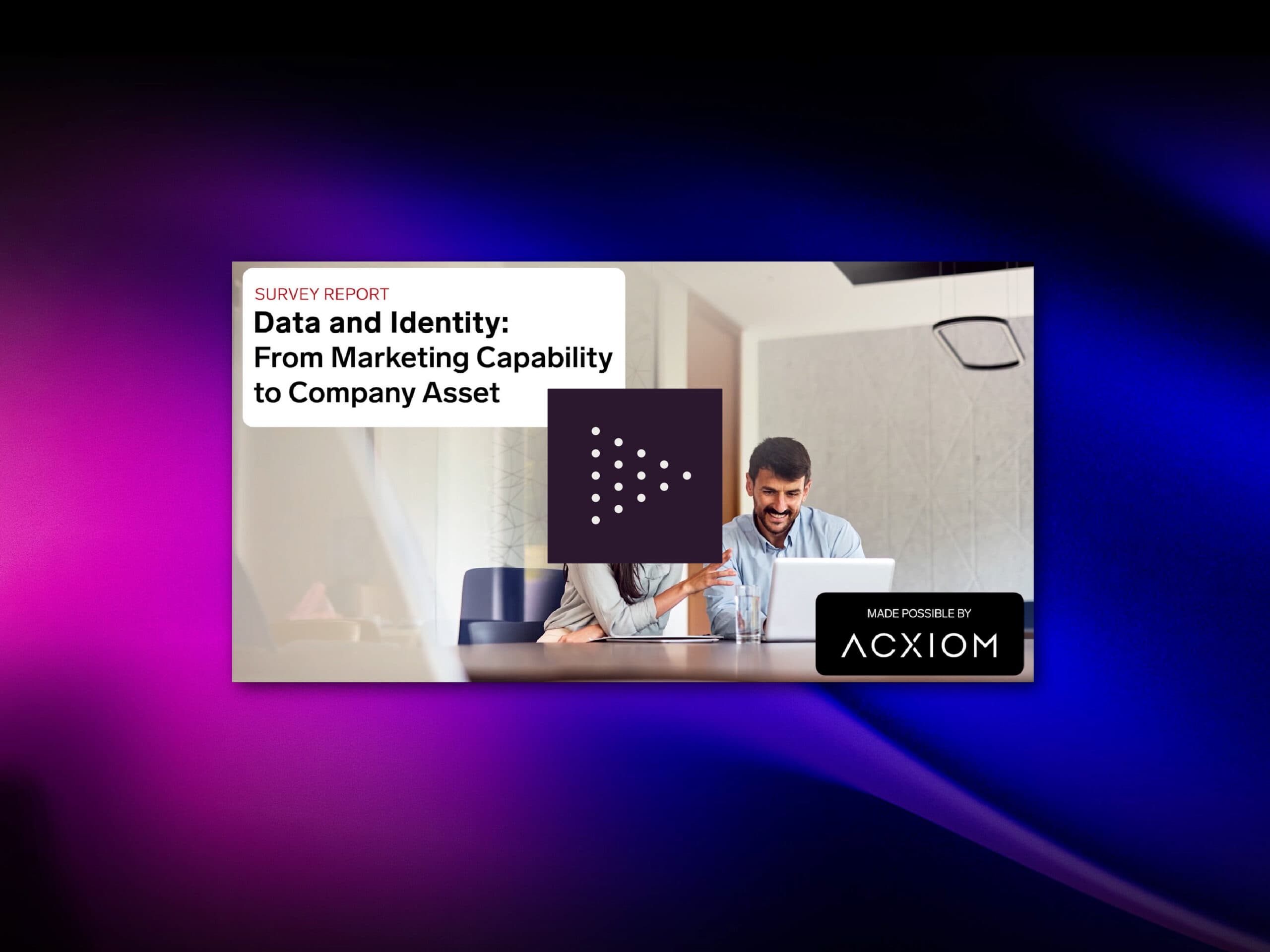
Businesses are beginning to realize that identity resolution is the golden thread in data strategy. Learn where business leaders are on their data and identity maturity journey — and how far is left to go — in our full report, From Data-Rich to Decision-Ready: How To Unlock Your Data Potential. You’ll gain expert analysis about where opportunities lie to consistently translate insights into business outcomes.


Subscribe to our blog
From the Blog