How do marketers overcome a fragmented, privacy-first landscape to deliver personalized experiences and earn trust and loyalty? The solution exists, but adoption lags. New research from Acxiom and EMARKETER reveals 90% of agency and marketing professionals already use identifiers of some kind. Because no single identifier works everywhere – email fails on connected TV and mobile apps, for example – marketers are layering multiple third-party IDs. (55% say they use more than one.)
This investment in identity resolution is producing measurable improvements, with more than 80% of marketers seeing improved ROI from their identity efforts. But there is a catch. Multiple identifiers can create a complete customer view and support tactics like personalization and journey orchestration only if they can be effectively linked. So brand ROI from identity investment will be compromised without the right infrastructure to make those connections.
The next phase of identity resolution is less about the availability of IDs and more about the ability to seamlessly stitch them together across channels and technology platforms to create the data foundation for agentic marketing. When executed effectively, brands will no longer depend on any single identifier or identity provider but will be able to choose the best one for each use case.
Interoperability has shifted from Advantage to Necessity
Interoperability unlocks three critical capabilities: a complete, unified view of every customer and prospect; predictive models trained on richer data, delivering sharper behavioral forecasts; and seamlessly connected journeys that guide people toward conversion. The payoff is measurable – brands with true interoperability drive higher conversion rates and revenue per customer.
Yet adoption lags far behind demand. As marketers layer more identifiers, signals, and systems to maintain continuity through signal loss, most lack the infrastructure to connect them. Just 23% report fully interoperable systems. Nearly two-thirds (64%) manage only partial interoperability, meaning fragmented customer views and weaker model performance that leave money on the table.
We can attribute this, in part, to an over-reliance on identifiers like email and hashed email – the most widely adopted digital identifiers, used by 65% of marketers. The usefulness of these identifiers is limited because they often aren't available for deterministic matching, requiring brands to take a hybrid approach that incorporates lower-quality signals and household-level marketing to achieve the desired scale and outcomes. They’re not necessarily available in environments like connected TV and mobile apps, or when someone is browsing anonymously. And they’re not freely shareable across platforms, creating gaps when people jump between devices and environments.
The inability to connect interactions across identifiers hinders brands’ readiness for AI-driven marketing, which 53% say their data foundation is unprepared to support. Connecting identity signals will enable AI models to be trained on complete customer profiles, improving behavioral prediction, personalization, and segmentation.
The priority for marketers today should be to unify identity inputs into a cohesive foundation that works across enterprise channels, platforms, and partners. As Keith Camoosa, chief product and technology officer at Acxiom, writes: “Smart brands today are focusing on interoperability between identifiers while investing in their first-party data, treating identity as an enterprise asset with a unified strategy.”
Camoosa asserts that interoperability between identifiers is especially important for brands in regulated industries like financial services. In this situation, poor interoperability doesn’t just negatively impact customer experiences, for example, customers receiving a credit card offer they’re not eligible for. It’s also a major liability for compliance and trust if customers have opted out of certain forms of communication or personalization, for instance, and these choices are not respected.
From fragmentation to interoperability
With 61% of marketers expecting their organization’s spending on identity to increase over the next 24 months, investments must prioritize interoperability as a core pillar to maximize ROI.
This means leaving behind single identifiers, siloed workflows, and point integrations that don’t support data connectivity, activation, and scalability across the marketing ecosystem. Instead, marketers need solutions and infrastructure that enable data to flow seamlessly and activate customer intelligence at scale.
Acxiom Real ID delivers interoperability by connecting internal identifiers, third-party solutions, and platforms – without rip-and-replace. It integrates with your existing stack, so your team skips the learning curve, and data flows seamlessly to power AI-driven activation.
Find out more in the full report
Interoperable identity solutions like Real ID enable consistent recognition, measurement, activation, and governance across the customer journey, helping brands move from fragmentation to connected, intelligent marketing.
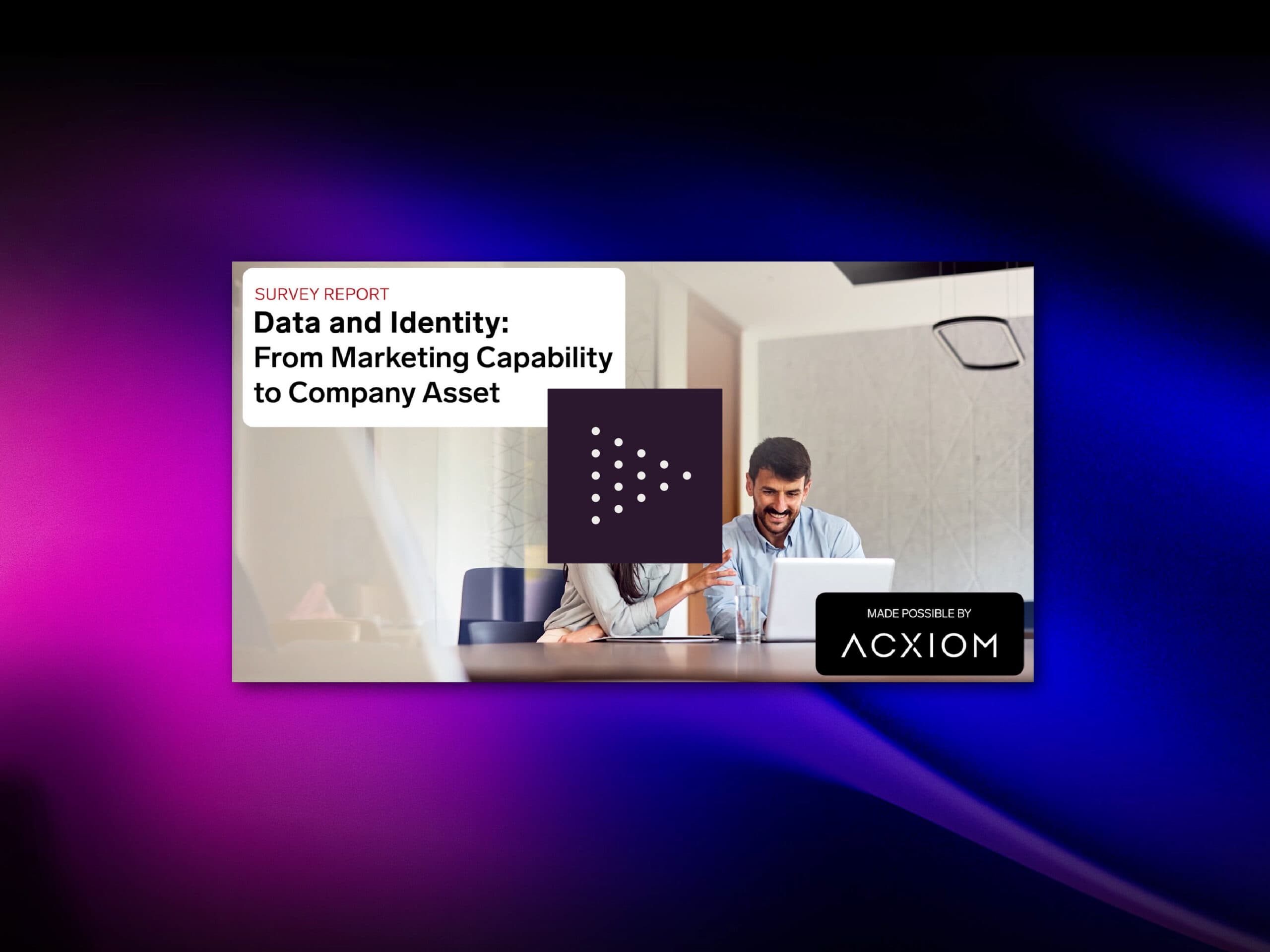
Learn what the data shows in our full report – Data and Identity: From Marketing Capability to Company Asset – to discover more about where marketers are along their identity journey. Expert analysts from Acxiom and EMARKETER explore what brands need to move their identity strategy forward and recommend five steps to take.


Subscribe to our blog
From the Blog