
The travel industry is ripe for AI adoption, with user journeys that span multiple touchpoints, require a high level of personalization, and often have high emotional stakes – making friction feel especially risky.
Today’s travel brands are already using AI in several ways to reshape CX strategies and improve efficiency, service levels, and attribution. But how do their customers actually feel about AI curating their experiences?
The travel and hospitality edition of our 2026 CX Trends Report digs into this question, exploring both brand and consumer perspectives on the AI-powered trends set to define CX in the industry next year. In this article, we unpack a few of the biggest takeaways to give you a flavor of our research – but to benefit from our full findings, be sure to download the report below.
Read the report: AI-curated experience in travel and hospitality →
The headwinds shaping CX strategy for travel and hospitality brands
It’s a challenging climate for travel brands, as people’s expectations continue to rise and products and services become increasingly complex. (Think more platforms, more partners, and all that associated data). With all that in mind, customer experience has never been more critical to competitive success.
We asked 100 leaders in travel and hospitality about the biggest external factors affecting their CX strategy. Here’s what they identified, in order of impact:
- Growth of digital-first competitors and AI-powered travel platforms
- Rising demand for real-time‚ personalized booking and service
- Difficulty driving loyalty in a convenience-led‚ choice-rich market
- Operational challenges
- Customer frustration with disconnected platforms and inconsistent experiences
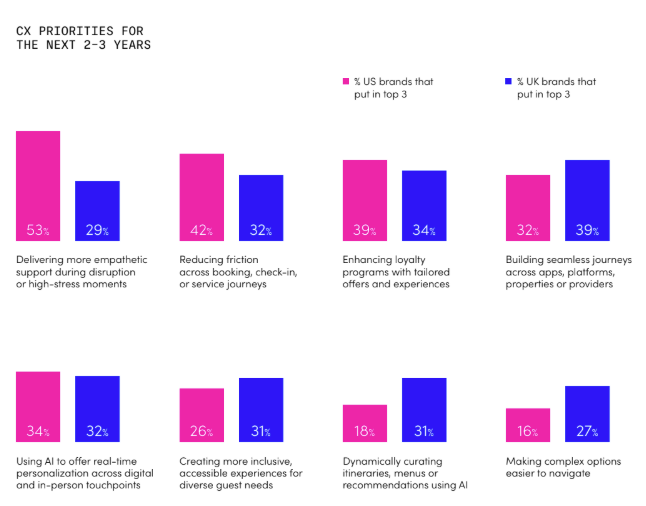
Travel brands are flexing CX strategies in response to these external forces, and this is reflected in their priorities for the next 2-3 years. For instance, when the market is saturated with almost infinite choices, it’s easy for people to go elsewhere. This makes sensitively handling pivotal moments, like complaints and issues, so crucial. So it’s no wonder 53% of U.S. travel brands say delivering more empathetic support during disruption is their number one CX priority. Meanwhile, both U.S. and U.K. brands are focusing on enhancing loyalty programs and reducing friction across booking and checking in.
Similarly, with people coming to expect customized products and services as standard, 34% of U.S. and 32% of U.K. travel brands surveyed say they’re already using AI to offer real-time personalization.
Is effort the enemy of the modern traveler?
Despite the improvements AI enables, 58% of people say it still takes too much work to get things done with brands – and that frustration is evident in their behavior. Last year, more than 40% of people switched providers, stopped using a brand, or abandoned a transaction due to friction in the experience.
Customer journeys are inevitably high-effort in the travel industry; the moving parts for a single trip can include flights, hotels, transfers, activities, and numerous other bookings. And even when these components can be booked through a single website or provider, each step poses the risk of friction.
Travel and hospitality brands are all too aware of the stakes, with 83% agreeing that effortless experiences will define the next generation of customer loyalty. But they’re also under no illusions about the risks of going all-in with AI in CX. Of the brands we surveyed, 30% say they fear losing the emotional connection or human touch in the race to deliver frictionless customer experiences, while 29% worry about compromising quality by moving too fast.
Fragmented journeys put customers on a different path
Another form of friction negatively impacting the customer journey is fragmentation: 73% of travel and hospitality customers say it’s frustrating to jump between apps or platforms just to achieve one thing. People also place the onus on brands to bridge the gap; three-quarters believe it’s a brand’s responsibility to make cross-platform journeys seamless, even when partners are involved. Despite this pressure, travel and hospitality is the industry least likely to use AI to orchestrate journeys across touchpoints or partners.
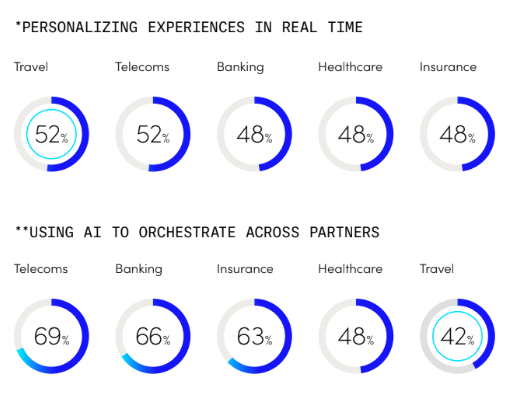
AI could fuel the development of a “universal interface” that unifies platforms and minimizes disruption, creating a continuous customer journey that moves seamlessly from one provider to the next. The question is, will this come at the cost of memorable experiences? A whopping 91% of brands believe AI has the power to unify customer journeys, but only brands can create memorable moments.
CX from the data foundation and up
Travel and hospitality brands are moving quickly to embrace AI in CX, but they don’t always have the strong data and identity foundation they need to properly put those solutions to work.
Whether they’re leveraging AI to enable better customer support, enhance loyalty, or reduce friction – travel brands need a deeper understanding of audience behaviors, expectations, and characteristics, so they can build customer experiences that anticipate (and exceed) their needs. That’s where Acxiom comes in – as a trusted partner for travel brands, we can help build the foundational data infrastructure needed to support AI-powered CX strategies.
Download the full report for a deeper dive
In this article, we’ve only scratched the surface of our findings. Download the full report, and you’ll learn:
- How travel and hospitality customers feel about voice and chat assistants
- The inverted priorities of brands and their customers when it comes to instructional AI
- Challenges travel brands are facing in the adoption of emotionally intelligent AI
- Details of our research methodology and sample